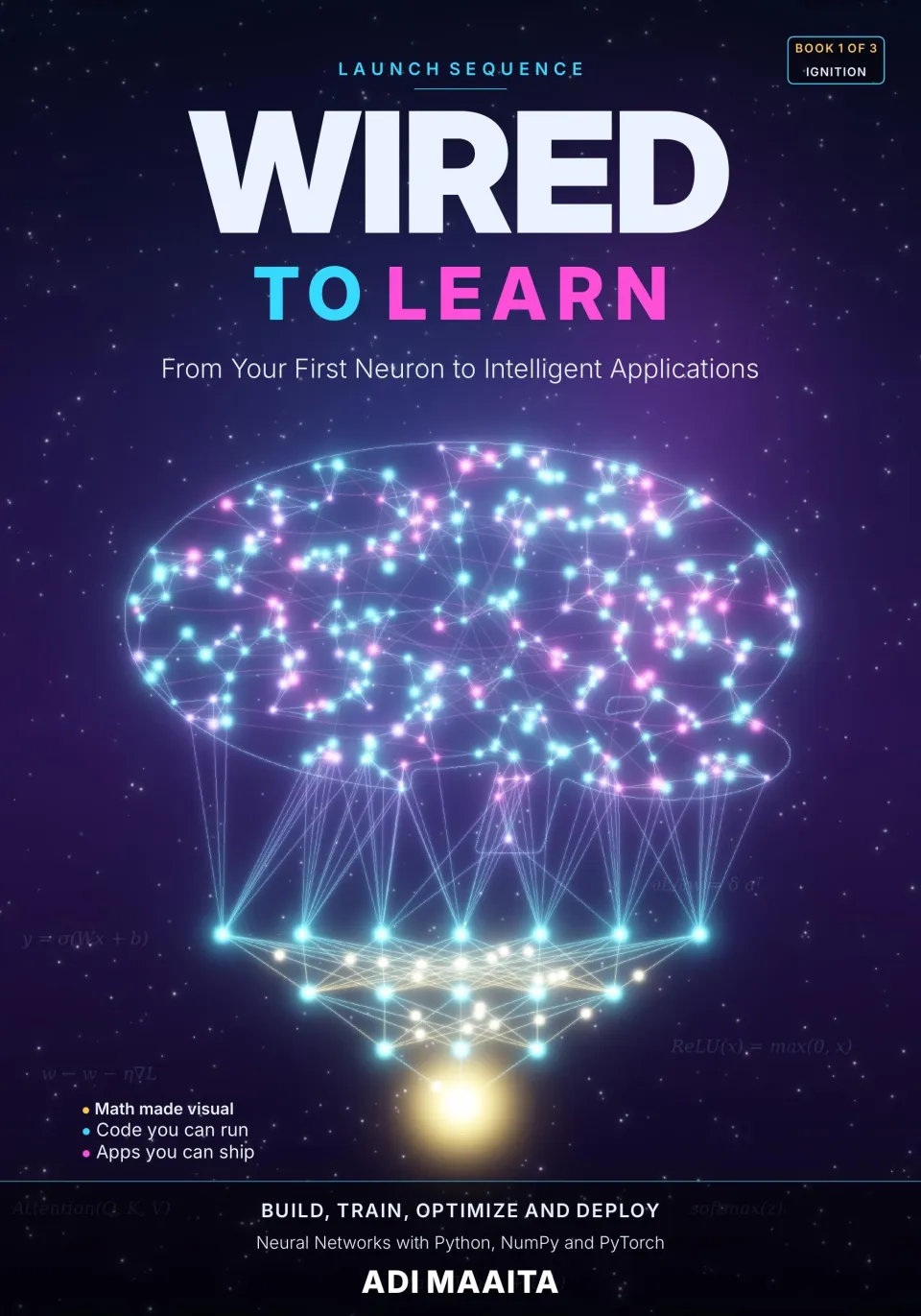
Wired to Learn
Build, Train, Optimize and Deploy Neural Networks with Python, NumPy and PyTorch
From Your First Neuron to Intelligent Applications
Understand neural networks deeply. Build them yourself. Ship them for real.
by Adi Maaita
- chapters
- 36
- parts
- 7
- appendices
- 4
- runnable listings
- 150+
- figures and tables
- 120+
- applications
- 6
Formats
Choose your format
Kindle eBook
$9.99
Print Replica edition: keeps the printed layout. Reads on the Kindle apps (phone, tablet, PC, Mac) and Fire tablets; not on e-ink Kindle readers.
Paperback
$42.99
ISBN-13 9798140254551
Hardcover
$54.99
ISBN-13 9798140308001
About the book
About the book
Understand neural networks deeply. Build them yourself. Ship them for real.
Most deep-learning books stop at one of two places: they explain the ideas and leave you unable to build anything, or they hand you library calls and leave the machine a mystery. Wired to Learn does the whole journey in one book. You write a deep-learning library from scratch in NumPy, move to PyTorch once nothing about backpropagation is hidden, and finish by using networks as components of six working applications.
Every program runs. Every listing in the book was executed, and the output printed beneath it, including the honest failures, comes from that run. The companion repository carries the expected output of every longer program so you can check your own, and the book's results were produced on an ordinary two-core laptop CPU, with no GPU required.
Who this book is for
You write Python and want to understand neural networks from the inside, well enough to build, debug and deploy them. Working developers who call AI libraries, students of computer science and software engineering, and teachers who want a course-length text with exercises and projects. You need high-school algebra; everything else is taught visually in Chapter 2.
How every idea is taught
- Intuition you can picture, before any symbols appear
- Math drawn as figures, 120+ of them, instead of walls of notation
- Code you write and run, every listing in the book and in the repository
What you will build
- Backpropagation, derived and coded by hand
- TinyNet, your own deep-learning library, then the same models in PyTorch
- A handwritten-digit reader: 98% with your own library, then 99% in PyTorch; CNNs with transfer learning, LSTMs, a mini-GPT, VAEs, GANs, a diffusion model and graph networks
- Self-supervised learning, reinforcement-learning agents and LoRA fine-tuning
- Models made smaller and faster with quantization, pruning and distillation, served with ONNX Runtime, FastAPI and Docker
- Six applications: a photo organizer, a ticket-triage assistant, a log anomaly detector, a demand-forecasting dashboard, a recommender and question answering over documents, plus testing and monitoring for all of them
Inside
36 chapters in seven parts, more than 500 pages, 150+ runnable listings, 120+ figures and tables, exercises with answers, and four appendices (Python and NumPy refresher, setup, math reference, answers). Python 3.12, NumPy, PyTorch 2, ONNX Runtime, FastAPI and Streamlit.
About the author. Adi Maaita is Director of Information and Communication Technology at King Hussein Cancer Center in Amman. A former Associate Professor of Software Engineering and Dean of the Faculty of Information Technology at Middle East University, with more than twenty years in academia and industry, he holds a PhD in Software Engineering from the University of Leicester. Wired to Learn is the first book in his three-book Launch Sequence series.
Open the sample, run the first network in Chapter 1, and see for yourself.
The method
How every idea is taught
Every program runs
Every listing in the book was executed, and the output printed beneath it, including the honest failures, comes from that run. The companion repository carries the expected output of every longer program, and the book's results were produced on an ordinary two-core laptop CPU, with no GPU required.
Part VII
The 6 applications you will build
- Smart Photo Organizer Chapter 30
- Ticket Triage Assistant Chapter 31
- Log Anomaly Detector Chapter 32
- Demand-Forecasting Dashboard Chapter 33
- Recommender System Chapter 34
- Question Answering over Documents Chapter 35
Table of contents
36 chapters in 7 parts, 4 appendices
Part I The Spark: Foundations 5 chapters
Part II Building a Brain from Scratch 4 chapters
Part III Training Like a Pro 5 chapters
Part IV The Network Zoo 8 chapters
- 15 Convolutional Neural Networks code/ch15
- 16 Modern CNNs and Transfer Learning code/ch16
- 17 Recurrent Networks: RNN, LSTM and GRU code/ch17
- 18 Attention, Transformers and a Mini-GPT code/ch18
- 19 Autoencoders and Variational Autoencoders code/ch19
- 20 Generative Models: GANs and Diffusion code/ch20
- 21 Graph Neural Networks code/ch21
- 22 Choosing the Right Network code/ch22
Part V Learning Beyond Labels 3 chapters
Part VI Maximum Performance 3 chapters
Part VII Intelligent Applications 8 chapters
- 29 Neural Networks as Application Components code/ch29
- 30 Project: A Smart Photo Organizer code/ch30
- 31 Project: A Ticket Triage Assistant code/ch31
- 32 Project: A Log Anomaly Detector code/ch32
- 33 Project: A Demand-Forecasting Dashboard code/ch33
- 34 Project: A Recommender System code/ch34
- 35 Project: Question Answering over Documents code/ch35
- 36 Testing, Monitoring and MLOps code/ch36
Appendices
- Appendix A: Python and NumPy Crash Course
- Appendix B: Setting Up Your Workshop
- Appendix C: Math Reference
- Appendix D: Answers and Hints
Read first, buy later
Free sample: the title pages and Chapter 1
A 12-page PDF. No sign-up needed.
Code & support
Companion code and corrections
launchsequencebooks/wired-to-learn
Every listing, with the expected output of every longer program.
Code & setup
Python 3.12 · NumPy · PyTorch 2 · ONNX Runtime · FastAPI · Streamlit · Docker
Setup guide →Teaching with this book? For instructors

About the author
Adi Maaita
Adi Maaita is Director of Information and Communication Technology at King Hussein Cancer Center in Amman. A former Associate Professor of Software Engineering and Dean of the Faculty of Information Technology at Middle East University, with more than twenty years in academia and industry, he holds a PhD in Software Engineering from the University of Leicester.
More about the author →FAQ
Common questions
Do I need a GPU?
No. The book's results were produced on an ordinary two-core laptop CPU, with no GPU required.
How much math do I need?
High-school algebra. Everything else is taught visually in Chapter 2.
How much Python do I need?
You should already write Python. Appendix A is a Python and NumPy crash course.
Where is the code?
In the companion repository, which carries the expected output of every longer program so you can check your own.
Which formats are there?
Kindle eBook, paperback and hardcover. Print Replica edition: keeps the printed layout. Reads on the Kindle apps (phone, tablet, PC, Mac) and Fire tablets; not on e-ink Kindle readers.
Can I read some of it first?
Yes. The free sample PDF has the title pages and Chapter 1.
Can I teach a course with it?
It is a course-length text with exercises and projects. Instructors who adopt the book are welcome to write to adi@adimaaita.com.
Book details
- Edition
- First edition, 2026
- Pages
- 523
- Trim size
- 7 x 10 in (17.8 x 25.4 cm)
- Interior
- Black and white
- Language
- English
- Publisher
- Launch Sequence Books
- ISBN-13 (Paperback)
- 9798140254551
- ISBN-13 (Hardcover)
- 9798140308001
Launch Sequence
Understand neural networks deeply. Build them yourself. Ship them for real.
Wired to Learn
from $9.99